|
V For Vendetta
Reviewed by Rich Drees
In the near future, a plague has decimated much of the world. In England, a rigid adoption of isolationism has kept its population safe, but at the cost of many of their civil liberties. Rigid curfews are enforced by a secret police force known as Fingermen. Homosexuals, Muslims and other “undesirables” have been expunged from society, their fate best not inquired about by the remaining population.
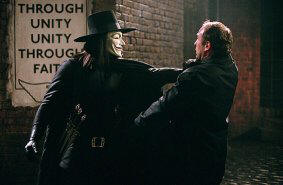
Caught outside after curfew, Evey (Natalie Portman) is saved from being raped by three Fingermen by a cloaked and Guy Fawkes-masked man who calls himself V (Hugo Weaving), who brings Evey along with him as he blows up London’s landmark Central Criminal Court, commonly referred to as the Old Bailey. The next evening V hijacks the state run television studio to join him one year hence when he will stage another major attack against another government building. But as the date of V’s promised attack grows closer, Evey begins to suspect that V’s campaign may be fueled by more personal reasons than he may care to admit.
Based on a comic strip that first ran in England from 1981 to 1985, the story was writer Alan Moore’s reaction to Britain under Prime Minister Margaret Thatcher. In translating the book to the screen, writers Andy and Larry Wachowski (the creators behind the Matrix trilogy) have contemporized some elements – the propaganda radio broadcasts have been replaced by a Rush Limbaugh-ish television commentator - which some may interpret as an open attack on the current United States presidential administration. However, such a read of the film would be shortsighted and superficial. The government in power is clearly more modeled on a Hitler/Stalin-esque form of fascism. If anything, the Prime Minister (John Hurt) issuing orders to his underlings via a wall-sized television screen recalls 1984 while Evey and V’s relationship certainly evokes The Phantom Of The Opera. There are many elements at work here, creating a sometimes dense dystopia.
In explaining why he is fighting back against the government, V explains to Evey “People should not be afraid of their government, government should be afraid of its people.” Is this V’s proactive rejection of Jefferson’s own statement that “Those who would give up a small amount of freedom for security deserve neither”? But as Evey learns, V’s campaign is in part motivated by the desire for revenge on those who tortured and experimented on him in a detainment camp. In the end, the movie forces us to ask ourselves a question that could very well be pertinent today- Can one take the moral high ground in claiming to be fighting for people’s freedom when you are in part motivated by revenge? |
 There are those who would dismiss a message simply because of the
medium it was delivered in. In the 1960s, many were dismissive of
the anti-Vietnam War movement in part because it used pop music as a
means of delivering its message to young people. During the most
recent presidential election, it can be argued that both major
parties underestimated the influence of internet bloggers. While it
is doubtful that the film V For Vendetta will have as a big a
singular impact on society as did the protest song or the blog, it
still carries a strong message that should not be dismissed simply
because it originates in movie based on a comic book.
There are those who would dismiss a message simply because of the
medium it was delivered in. In the 1960s, many were dismissive of
the anti-Vietnam War movement in part because it used pop music as a
means of delivering its message to young people. During the most
recent presidential election, it can be argued that both major
parties underestimated the influence of internet bloggers. While it
is doubtful that the film V For Vendetta will have as a big a
singular impact on society as did the protest song or the blog, it
still carries a strong message that should not be dismissed simply
because it originates in movie based on a comic book.