|
The Host Reviewed by Rich Drees
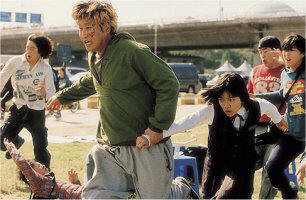
Already one of the biggest hit films in Korea cinema history, The Host is a remarkable movie that transcends any preconceived notions one may have about its monster movie genre roots. Director Joon-hu Bong, who shares a writing credit on the film, has created a quartet of quirky, yet believable, characters in the quartet of Gang-Du, his two siblings and their father. Where in a majority of horror films comic moments often come in the form of characters reacting in disbelief to the extraordinary events unfolding around them, the instances of comedy relief here come out of the interaction between the Park family as they struggle to work together to rescue Hyun-seo. Their coming to terms with each other forms the main plot of the film, with the monster attacks serving as only a device to set and keep their story in motion. Think The Royal Tenenbaums (2001) set against a backdrop of Godzilla. The “less is more” method of relegating the creature to the background of the narrative also helps to make its appearances all the more powerful.
That is not to say that Bong neglects the elements that fans of monster movies crave. The creature’s attacks are exciting, scary and kinetically staged. Bong gracefully balances the suspense of these scenes against the dramatic and comedic moments without letting anyone overpower the other.
For a film
produced on a fraction of Hollywood’s big-budgeted, special-effects
extravaganzas, the computer-created creature is remarkably realistic
and impressive, only stumbling – though not unforgivably – for a few
shots during the final confrontation with the creature. Much thought
appears to have been put into the lifecycle of the creature – its
feeding habits and how it relates to its environment – making the
mutant the most believable movie monster to grace the big screen
since the first appearance in 1979 of Ridley Scott’s Alien.
One would certainly not go amiss if they were to read some criticism of recent U.S. foreign policy into The Host. The movie clearly states that the mutant was created by chemicals dumped into the river from a nearby U.S. army base. Once it is learned that the monster may be spreading a virus similar to Bird Flu – information supplied by the U.S.’s own Center for Disease Control – the United States announces that the Korean government has only a short time to get the situation under control before they will intervene. As fear of the virus begins to spread through Seoul, people begin reacting suspiciously to anyone who so much as coughs. We later learn from a conversation between a U.S. Army doctor and his assistant that the virus is a fiction created by the U. S. government.
Such commentary in monster films is not uncommon, and indeed, is even the hallmark of many of the classics of the genre. Mary Shelley’s original novel Frankenstein and many of its film iterations address on one level or another man’s relationship with technology and the fear of losing control of that technology. The original Godzilla (1954) was a reaction to Japan’s horror to the atomic bombings of Hiroshima and Nagasaki while films like The Thing From Another World (1951) and Invasion Of The Body Snatchers (1956) mirrored Americans’ concerns about communist infiltration. And like these classics, The Host’s subtextual commentary never overwhelms the film’s story or excitement. |
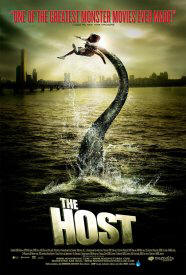 An idyllic day at a Seoul, Korea riverside park is shattered by an
attack from a giant mutated squid-like creature who terrorizes and
kills several people before disappearing back under the river’s
surface. In the wake of the attack, Gang-Du (Kang-ho Song), who runs
a local snack stand with his father (Hie-bong Byeon), is left
devastated, having seen the creature drag his daughter Hyun-seo
(Ah-sung Ko) underwater when it disappeared. Confined to a hospital
for observation, Gang-Du receives a cell phone call from Hyun-seo,
who has been taken by the creature to a remote chamber in the vast
sewer system under the city. Gang-Du, along with his archery
champion sister Nam-il (Hae-il Park) and unemployed,
college-graduate brother Nam-joo (Du-na Bae) and their father,
escapes from the hospital to mount a rescue mission, if the three
siblings can stop quarrelling amongst themselves first.
An idyllic day at a Seoul, Korea riverside park is shattered by an
attack from a giant mutated squid-like creature who terrorizes and
kills several people before disappearing back under the river’s
surface. In the wake of the attack, Gang-Du (Kang-ho Song), who runs
a local snack stand with his father (Hie-bong Byeon), is left
devastated, having seen the creature drag his daughter Hyun-seo
(Ah-sung Ko) underwater when it disappeared. Confined to a hospital
for observation, Gang-Du receives a cell phone call from Hyun-seo,
who has been taken by the creature to a remote chamber in the vast
sewer system under the city. Gang-Du, along with his archery
champion sister Nam-il (Hae-il Park) and unemployed,
college-graduate brother Nam-joo (Du-na Bae) and their father,
escapes from the hospital to mount a rescue mission, if the three
siblings can stop quarrelling amongst themselves first.