|
Stardust Reviewed By Rich Drees
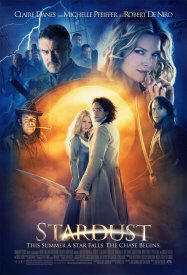
Stardust sees Gaiman’s world-building skills in full effect, creating a world which feels familiar yet unique to itself. In England of long ago, a simple stone wall is all the seemingly separates the magical kingdom of Stormhold from the rest of the world. Although succession to the kingdom’s throne is done through a process where the King’s sons murder each other, the rest of the kingdom goes about its business in fairly peaceful fashion. When a star falls from the sky, it ignites a three-way race to retrieve it. Tristan (Charlie Cox) crosses over the wall into Stormhold, which is quite forbidden, to fetch it back to impress the beautiful and unattainable Victoria (Sienna Miller). The witch Lamia (Michelle Pfeiffer) wants the star as it holds the power to restore youth to her and her two centuries-old sisters. Meanwhile, Prince Septimus (Mark Strong) needs the star to claim the kingdom’s throne in a last-minute change to tradition courtesy of his dying father (Peter O’Toole).
The first to arrive at the spot where the star has landed, Tristan is surprised to discover that the star has the form of a beautiful woman named Yvaine (Claire Danes). With Yvaine a reluctant partner, Tristan finds himself on the run from Septimus and Lamia, finding allies in the unlikeliest of places, including a pirate (Robert DeNiro) who literally knows how to capture lightening in a bottle.
Since there are some familiar fairy tale tropes that Gaiman worked with in the original story, it seems natural that some of the plot revelations can be seen coming from the moment they are first set up. But whether the film works as a good adaptation of Gaiman’s original work can be left to his fans to debate. The uninitiated, though, should have no trouble enjoying the film on its own merits. |
 Neil Gaiman is probably the leading fantasist writing today. In his
seminal comic series Sandman and his prose novels like
American Gods, he takes existing mythologies, and simultaneously
injecting them with new ideas and giving them a postmodern spin.
Neil Gaiman is probably the leading fantasist writing today. In his
seminal comic series Sandman and his prose novels like
American Gods, he takes existing mythologies, and simultaneously
injecting them with new ideas and giving them a postmodern spin. Director Matthew Vaughan has delivered a movie that is stylistically
distinct from his debut film, the crime drama Layer Cake
(2004). Stardust is a delightful romantic fantasy that
combines imaginative visuals, moments of humor and horror that add
spice to its rousing adventure plotline. Cox does an adequate job as
the films’ hero, a performance that is almost overshadowed by
Strong’s work as Septimus. But the film really belongs to the women
of the cast with Danes, Pfeiffer and Miller all delivering strong
performances. It’s not often one sees well fleshed-out roles for
women and Yvaine and Lamia, and to a lesser extent Victoria, are all
exceptions to that rule.
Director Matthew Vaughan has delivered a movie that is stylistically
distinct from his debut film, the crime drama Layer Cake
(2004). Stardust is a delightful romantic fantasy that
combines imaginative visuals, moments of humor and horror that add
spice to its rousing adventure plotline. Cox does an adequate job as
the films’ hero, a performance that is almost overshadowed by
Strong’s work as Septimus. But the film really belongs to the women
of the cast with Danes, Pfeiffer and Miller all delivering strong
performances. It’s not often one sees well fleshed-out roles for
women and Yvaine and Lamia, and to a lesser extent Victoria, are all
exceptions to that rule.