Solaris
Reviewed by Rich Drees
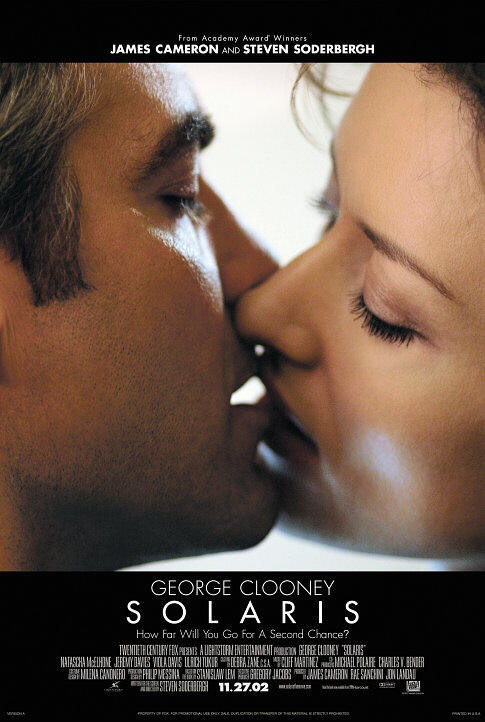 Steven Soderbergh’s new film
Solaris is a rarity- It’s a
science fiction film with no space battles, explosions, laser guns, horrible
alien monsters or cute comedy relief robots. And thank heavens for that.
Steven Soderbergh’s new film
Solaris is a rarity- It’s a
science fiction film with no space battles, explosions, laser guns, horrible
alien monsters or cute comedy relief robots. And thank heavens for that.
Instead, what Soderbergh has done is craft an intelligent, meditative piece on how we cope with death and how we consciously or unconsciously choose to remember the departed loved ones in our lives.
George Clooney stars as Chris Kelvin, a psychiatrist called out to a space station in orbit around the ocean world of Solaris by his friend Gibarian. When he arrives, he finds Gibarian dead and the only two remaining station personnel unwilling to explain what has been happening, instead telling him that he'll have to experience the phenomenon plaguing the station for himself.
That night, Kelvin dreams of his dead wife
only to find her next to him the next morning, very much alive. As Kelvin
continues to probe the mystery of what is happening to on the space station, he
is also forced to confront his own feelings over his wife's death.
What could have been executed as a bad episode of Star Trek is instead quite simply one of the most intelligently scripted science-fiction films in the last ten years. As a film genre, science-fiction has all too often been bogged down with the adventure of marauding alien monsters or the spectacle of exploding planets. If Solaris seems to be more in line with literary science-fiction, it's no accident. The film is based on a novel by European author Stanislaw Lem and has been adapted once before by Russian director Andrei Tarkovsky in 1973.
 George Clooney underplays
his part as a psychiatrist who is trying to remain emotionally distant from the
sudden appearance of the simulacrum of his dead wife, but can’t fight the deep
emotional bond he still has for her. This is by far Clooney's best performance
in a film yet, but since it is so measured and controlled many may dismiss
it out of hand.
George Clooney underplays
his part as a psychiatrist who is trying to remain emotionally distant from the
sudden appearance of the simulacrum of his dead wife, but can’t fight the deep
emotional bond he still has for her. This is by far Clooney's best performance
in a film yet, but since it is so measured and controlled many may dismiss
it out of hand.
To be sure, some will want to make comparisons to Kubrick’s 2001: A Space Odyssey, but beyond a few base similarities- the slow, deliberate pace, a space mission that has possibly entered into a first contact situation- they are their own, separate films. If anything the two films share an ability to stimulate some conversation after viewing, a trait that seems to be extinct in other science-fiction films.