Shall We Dance?
Reviewed by Rich Drees
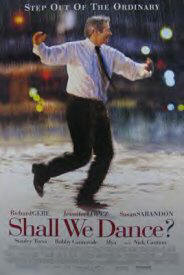 Unfortunately, Lost In Translation has already been used as a film
title recently, as it could very much be used to describe Shall We Dance?,
an American remake of a critically acclaimed 1996 Japanese film. Those
familiar with the original version will find no real surprises here, as this
Americanization apes its source’s every story beat.
Unfortunately, Lost In Translation has already been used as a film
title recently, as it could very much be used to describe Shall We Dance?,
an American remake of a critically acclaimed 1996 Japanese film. Those
familiar with the original version will find no real surprises here, as this
Americanization apes its source’s every story beat.
John Clark (Richard Gere) is a Chicago lawyer feeling the mind-numbing weight of having spent the last two decades helping people prepare the wills. Although he has a good job, a fine home in the suburbs, loving family, something still seems to missing. After seeing a sad but attractive woman (Jennifer Lopez) staring out of a dance studio window from his train ride home, he impulsively enrolls at the studio in beginner ballroom dance lessons. Although the woman, an instructor at the studio named Paulina, tells Clark that she doesn’t fraternize with students, he continues to his lessons. As the weeks go on and John improves he's encouraged to enter an upcoming dance competition with Paulina as his partner. However, as John spends more time at the studio preparing for the contest, his wife (Susan Sarandon) begins to suspect he is having an affair.
While the story structure veers little from its source material, the film’s tone does. Although set against the backdrop of the Western originated art of ballroom dancing, the original version of Shall We Dance? is very much a product of Japanese society. For the lead character (played by Koji Yakusho) to do something as different as taking dance lessons was considered virtually taboo. It’s this internal conflict that drives the film’s narrative. Since this won’t play in America’s much less rigid social setting, the screenwriter has opted to turn John and his fellow student’s attempts to dance into a light comedy. The studio is stocked with an array of characters just oddball enough to be charming, essayed by a strong cast of comedic actors. Bobby Canavale and Omar Miller deliver laughs as John’s classmates and Lisa Ann Walter almost steals the film as a brassy dancer who seems to be channeling the spirit of the Divine Bette Middler.
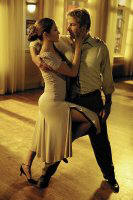 Unfortunately, midway through the movie the plot kicks into high gear,
demanding the drama quotient be ratcheted up as John’s wife discovers where
he has been sending his Wednesday nights. The film swings from light comedy
to dour drama and never fully recovers its balance in time for the climactic
dance competition scene. The original film much more competently balanced
its dramatic moments with lighter, comic beats.
Unfortunately, midway through the movie the plot kicks into high gear,
demanding the drama quotient be ratcheted up as John’s wife discovers where
he has been sending his Wednesday nights. The film swings from light comedy
to dour drama and never fully recovers its balance in time for the climactic
dance competition scene. The original film much more competently balanced
its dramatic moments with lighter, comic beats.
The bipolar tone isn’t the screenplay’s only fault though. Whereas the original used a few well conceived shots to convey its lead character’s growing ennui with his life, this version uses a voiceover from John to tell us how dissatisfying his life is. It’s a hackneyed trick that violates the classic story telling dictum, “Show, don’t tell.” Also, no attempt has been made to give Stanley Tucci’s character, whose actions in the original are also very much dictated by the rigors of Japanese culture, a motivation that would work better within the context of American culture.
Unlike the recently released Taxi, Shall We Dance? is not an aggressively bad remake of a foreign film. Still, giving this version a pass and tracking down a copy of the original film would better serve movie watchers.