The Mayor Of The
Sunset Strip
Reviewed by Rich Drees
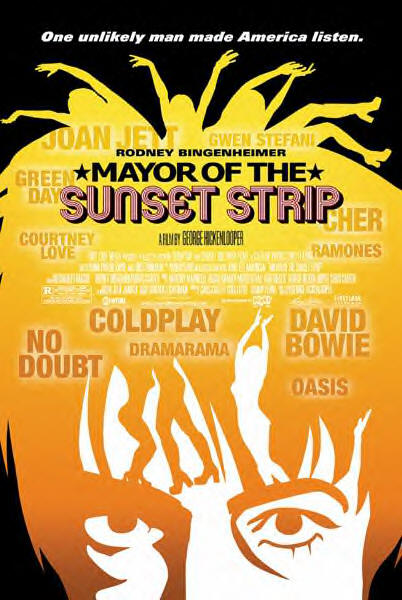 Perhaps the most influential man in the rock music industry (And let's face
it. For all the posturing that goes on about artistic vision and the spirit
of rock and roll rebellion, it is still an industry.) is not a major label
executive, a high powered concert promoter, a keen record producer or even a
savvy agent. It's been a gangly disc jockey with a page boy haircut named
Rodney Bingenheimer.
Perhaps the most influential man in the rock music industry (And let's face
it. For all the posturing that goes on about artistic vision and the spirit
of rock and roll rebellion, it is still an industry.) is not a major label
executive, a high powered concert promoter, a keen record producer or even a
savvy agent. It's been a gangly disc jockey with a page boy haircut named
Rodney Bingenheimer.
If you're not from Los Angeles than odds are you probably haven't heard of Bingenheimer, but for 25 years he has been a mainstay of KROQ radio, discovering and giving air play to a variety of rock acts from Blondie and the Ramones to No Doubt and Coldplay. Before that he ran an influential rock club. He had also served as a PR man for a variety of record labels, escorting the likes of an as yet unknown David Bowie around to Los Angeles radio stations trying to get them to play his record.
Even before Rodney's arrival in Hollywood, he seemed to gravitate towards
celebrity. In 1963 he tried to call President Kennedy at the White House.
Once arriving in Hollywood, it didn't take him too long to land his first
job as Davy Jones' double on The Monkees TV series. Before long he had
effortlessly integrated himself into the Los Angeles celebrity culture. The
film contains clips of television performances by the likes of Jerry Lee
Lewis and the Mamas and the Papas with Bingenheimer appearing Forrest
Gump-like in the background and pictures of him with everyone from guitarist
Jimmy Hendrix to the cast of Gilligan's Island. Yet throughout it all,
Bingenheimer seems fazed by the magnitude of some of the stars he knows and
manages to stay never fall into a star trip of his own. He seems to have
stayed just an average joe over the years, free flitting back and forth
between big time Hollywood parties and his regular booth at a suburban
Denny's Restaurant. "I like to think I'm the designated driver between the
famous and the not-so-famous," he says.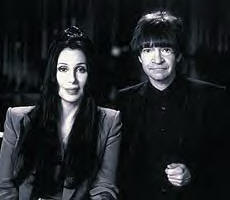
There is an impressive array of rock talent who has been recruited for to discuss how Bingenheimer had helped their career. Cher, David Bowie and Courtney Love, artists who very much represent different eras in rock history all talk enthusiastically about Bingenheimer. Michael des Barres, of the group Detective, is such an energetic and funny interview that one wishes for a separate documentary of just him telling stories from his halcyon days.
Bingenheimer is an amiable, unpresupposing sort. So it comes as a bit of a surprise towards the end of the film when he has an heated and vulgar laden argument with Chris Carter, former member of Dramarama (a band Bingenheimer had championed) turned disc jockey (who got his job at KROQ with Bingenheimer's help) over that fact that Carter was set to host a show similar in concept to what Bingenheimer had been doing for the station. What's disappointing is that the film doesn't follow up on this exchange. No more mention of it is made. Though perhaps this omission could be explained away by mentioning that Carter is one of the producers of the documentary.
There is a touch of sadness to the film. As music has changed, it's possible that Bingenheimer is becoming a relic of the past. His taste has always run towards melody driven pop hooks, far different from much of today's rap and hard core groups. The radio station that he had helped to define and build into a hit-making powerhouse has relegated him to a Sunday midnight to three a.m. shift. A fellow disc jockey opines that the station is probably too afraid of any bad publicity to fire Bingenheimer. But, the apparent indifference of his employer and the less than ideal air shift so nothing to deter his spirit. He still keeps playing the music he likes, and keeps an ear out for the next big thing.