The Matrix Reloaded
Reviewed by Rich Drees
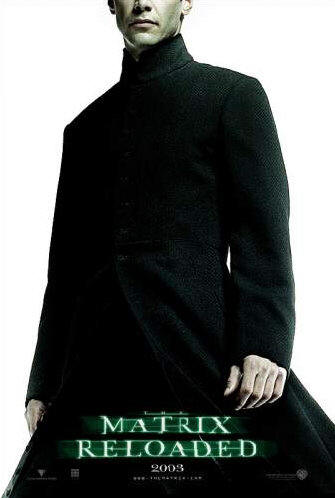 It doesn’t matter what I
say here; you’re going to go see The Matrix Reloaded. The
advertisements for this movie have been omnipresent for the last month or
so, even to the point where they have become embedded in other commercials
for beer and sports drinks. In the May 16, 2003 Matrix Reloaded cover
story for Entertainment Weekly producer Joel Silver was crowing to
the reporter about how the film was setting new records in audience
awareness surveys. (This was the second time within 5 weeks that the movie
graced the magazine’s cover. Entertainment Weekly is published by
Time, Inc., a part of the AOL-Time-Warner conglomerate. The Matrix
films are being released by Warner Brothers, another arm of the media giant.
To quote EW’s cover copy for the May 16th Matrix
Reloaded cover story, “You do the math”.) So, yeah, a lot of people will
be going to see this movie.
It doesn’t matter what I
say here; you’re going to go see The Matrix Reloaded. The
advertisements for this movie have been omnipresent for the last month or
so, even to the point where they have become embedded in other commercials
for beer and sports drinks. In the May 16, 2003 Matrix Reloaded cover
story for Entertainment Weekly producer Joel Silver was crowing to
the reporter about how the film was setting new records in audience
awareness surveys. (This was the second time within 5 weeks that the movie
graced the magazine’s cover. Entertainment Weekly is published by
Time, Inc., a part of the AOL-Time-Warner conglomerate. The Matrix
films are being released by Warner Brothers, another arm of the media giant.
To quote EW’s cover copy for the May 16th Matrix
Reloaded cover story, “You do the math”.) So, yeah, a lot of people will
be going to see this movie.
Not that that should be a surprise, advertising blitz notwithstanding. With its combination of existential philosophy, Hong Kong cinema inspired action sequences and eye popping visual effects, the first Matrix film was the surprise hit of spring 1999, raking in $172 million dollars outside of the traditional summer blockbuster season. Keanu Reeves is computer hacker Neo, who is shown by the enigmatic Morpheus (Laurence Fishburn) that what he thinks is reality, is just an artificial construct designed by computer intelligences to keep humanity unaware of their enslavement. Morpheus believes that Neo is the prophesized hero who will lead the human race out of bondage. In parts inspired by Joseph Campbell, Descartes, and Japanese animation, Neo spends the course of the first film accepting his destiny and mastering his unique powers while fighting the black-suited Agents of the Matrix led by Hugo Weaving.
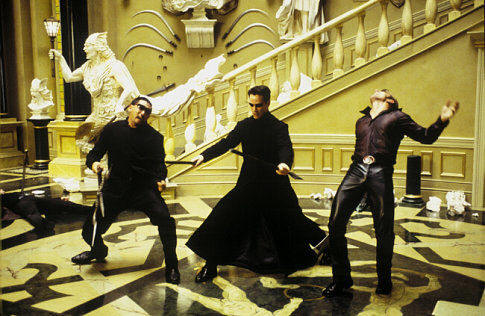 Some time has past since the events of the first film. Neo, Morpheus and
Trinity are still fighting against the Agents of the computers that control
the Matrix. They have been waiting for information from The Oracle (Gloria
Foster), a rogue program within the system who foresaw that Neo would be the
one to free humanity. The Oracle warns them that the computer intelligences
are planning an attack on the city of Zion, the subterranean last refuge of
the few free humans. In order to stop the attack, they must find the
Keymaker. Standing in their way is the
system’s anonymous Agents. Agent Smith (Weaving), supposedly destroyed by
Neo at the end of the last film is back, though somewhat changed by his last
encounter with Neo.
Some time has past since the events of the first film. Neo, Morpheus and
Trinity are still fighting against the Agents of the computers that control
the Matrix. They have been waiting for information from The Oracle (Gloria
Foster), a rogue program within the system who foresaw that Neo would be the
one to free humanity. The Oracle warns them that the computer intelligences
are planning an attack on the city of Zion, the subterranean last refuge of
the few free humans. In order to stop the attack, they must find the
Keymaker. Standing in their way is the
system’s anonymous Agents. Agent Smith (Weaving), supposedly destroyed by
Neo at the end of the last film is back, though somewhat changed by his last
encounter with Neo.
Matrix Reloaded expands on the world that was only hinted at in the first film. Inside the Matrix, audiences are introduced to new characters and learn secrets about old ones. Out in real world, we finally get to see Zion. Unfortunately, it turns out that this last outpost of humanity looks like an unending rave party. It seems that Matrix Reloaded writer/director duo, the Andy and Larry Wachowski. have forgotten that this is the second act of a three act play. The situations introduced in the first film should be complicated, not abandoned for something new. At the end of the first film, Neo is shown to have basically god-like powers to re-write the Matrix at will. Yet in Matrix Reloaded, he constantly is lowering himself to his opponents level and fighting them with kung fu.
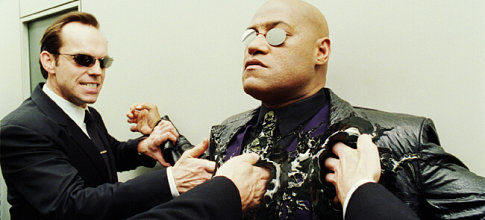 The Wachowski are definitely playing to the balcony with this film. The
action sequences and flashy visuals are at the forefront while the
philosophical underpinnings that marked the first film as a step above the
usual actioner have been pushed into the background. There is some lip
service to the idea of making choices but it only serves to set up a rather
obvious action beat at the end. As was the first film, Reloaded is an
amalgam of many sources, cribbing from movies as diverse as Tron and
Sam Raimi’s Crimewave USA. Ultimately, though, The Matrix Reloaded
comes off as a movie that is far too in love with it’s own style to match
the substance of the original.
The Wachowski are definitely playing to the balcony with this film. The
action sequences and flashy visuals are at the forefront while the
philosophical underpinnings that marked the first film as a step above the
usual actioner have been pushed into the background. There is some lip
service to the idea of making choices but it only serves to set up a rather
obvious action beat at the end. As was the first film, Reloaded is an
amalgam of many sources, cribbing from movies as diverse as Tron and
Sam Raimi’s Crimewave USA. Ultimately, though, The Matrix Reloaded
comes off as a movie that is far too in love with it’s own style to match
the substance of the original.