The Manchurian Candidate
Reviewed by Rich Drees
 Director
Jonathan Demme is proof of the old adage about trying again if at first you
don't succeed. After his remake of Charade (1963) resulted in the
rather abysmal They Trouble With Charley, Demme steps up to the plate
again with a retelling of the 1962 Frank Sinatra political thriller The
Manchurian Candidate. While he doesn't knock the film out of the park,
Demme does score a solid base hit.
Director
Jonathan Demme is proof of the old adage about trying again if at first you
don't succeed. After his remake of Charade (1963) resulted in the
rather abysmal They Trouble With Charley, Demme steps up to the plate
again with a retelling of the 1962 Frank Sinatra political thriller The
Manchurian Candidate. While he doesn't knock the film out of the park,
Demme does score a solid base hit.
Thirteen years after serving in Kuwait, Major Ben Marco (Denzel Washington) is approached by a former platoon-mate who claims to be having nightmares of a particular mission in which their comrade-in-arms Lieutenant Raymond Shaw (Liev Schrieber) won a Congressional Medal of Honor for bravery. Although Marco denies it, he too has been troubled of late by dreams depicting those events that don't match his recollections of what happened. Marco’s anxiety increases when it is announced that Shaw, now a New York congressman, will be running for vice-president in the upcoming election. Marko manages to contact Shaw, who tells him that he has been troubled by dreams, but that if he were to seek help it would jeopardize the campaign he had been thrust into by his manipulative mother (Meryl Streep), a Senator from Virginia. Once his own and with Election Day approaching, Marco must unravel the mystery of what happened to his platoon and what the implications may be.
Knowing
that most people are probably already familiar with the conceit of the
original version of The Manchurian Candidate, Demme chooses to let
the audience know up front the brainwashing aspect of the plot. Since the
original's Red Chinese culprits would seem dated today, Demme has changed
the villains of the piece and lets the film's suspense build from Marco's
attempt to discover who is responsible and what their ultimate aim is. The
script even manages a couple of lines that slyly hint at things the
characters don't know yet, such as when Shaw's mother tells him "Maybe
that's how you remember things" in a conversation about an old girl friend
of his. The film does stay away from being a mere updating of the original
and in addition to the new villain of the piece, screenwriters Daniel Pyne
and Dean Georgaris have added a few changes to the final third of the film
that are designed to keep the audience guessing. Whether any of these
changes succeed or not depends on how well versed one is with other
thrillers in a similar vein to this.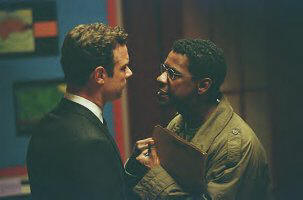
What really hampered Demme on The Trouble With Charley was the mis-casting of Mark Wahlberg and Thandie Newton who shared none of the chemistry that Cary Grant and Audrey Hepburn had in Charade. With Manchurian Candidate, Demme has assembled a much stronger cast and when the film succeeds, it is on this basis. Washington delivers a fine performance that walks an increasingly thinning line between driven and demented as the film progresses. When we first meet Marco it's while he is addressing a group of Boy Scouts about his time in active combat during the first Gulf War, seemingly untouched by those events. It's only when he arrives home at his apartment, following his encounter with his former platoon-mate that we see the mental and physical toll his own troubling dreams have been taking on him. As Marco digs deeper into the events hinted at in his dreams, Washington slowly shades his performance with increasing degrees of frustration and paranoia until he confirms his own suspicions about what has been done to him. Streep's manipulative Senator is a delicious star turn that could have easily gone over the top but doesn’t.