|
15th Annual Philadelphia Film Festival Reviews
By Rich Drees
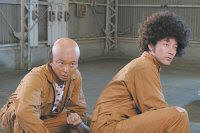
An improbable trash heap cum illegal dumping grounds for toxic waste and inconvenient bodies named Mt. Dark Fuji is the point of origin for a zombie invasion of Tokyo. “At last we have true zombies in Japan!” exclaims an ecstatic television commentator. When the shambling hoards of the undead become too much a nuisance for improbably coifed friends Tadanobu Asano (who starred in last year’s Festival Favorite Survive Style 5+) and Sho Aikawa (the Dead Or Alive trilogy) to deal with, they attempt to flee the city in a rickety ice cream truck, encountering the usual problems one seems to encounter while fleeing zombies. The directorial debut of writer/actor Sakichi Sato (screenwriter of Takishi Miike’s Ichi The Killer and who appeared as the “Charlie Brown” Waiter in Quentin Tarantino’s Kill Bill, Vol. 1), Tokyo Zombie is a gonzo parody of the zombie genre. Downplaying the gore and emphasizing physical comedy, Tokyo Zombie is more slapstick than splatstick. True to form for zombie flicks, one of the friends is bitten and sacrifices himself so the other can get away. It’s at this point the film makes a stumble from which it almost doesn’t recover- jumping five years into the future where the surviving residents of Tokyo live in a walled complex with the poor serving as either slave labor or fighting in a gladiatorial arena against zombies for the amusement of the rich. While the second half of the film is not as madcap as the first half, it does play as a riff on George Romero’s Land Of The Dead and also serves to set up the film’s final punch line. Screening for the first time outside of Japan at the Philadelphia Film Festival, Tokyo Zombie is certainly tailor-made to become a cult classic amongst Asian film aficionados.
Midnight, My Love is an unlikely and subtle love story between a taciturn Bangkok taxi driver and the young prostitute whom he drives home every evening. Bati (Petchtai Wongkamlao) is a quiet man, trying to forget a dark moment in his past and content with listening to old Thai pop songs and radio dramas while cruising the city’s streets for late night fares. When he finds himself hired to nightly drive a young prostitute named Nual (Woranut Wongsawan) home after she finishes her shift at a high class bordello, he soon finds himself drawn into helping her out of her situation. However, as their friendship grows, Bati finds himself too ashamed of his past to open up to Nual. As tension in their relationship mounts, Bati becomes more obsessed and desperate to create for himself and Nual a happily-ever-after ending to their story. A surprisingly taut and tender story, Midnight, My Love keeps its audience in suspense until the very last moments as to whether Bati will succeed.
Bringing new meaning to the term “shotgun wedding,” a complaint over
bad shrimp escalates into open warfare between a groom’s father
(Armin Rhode, who, with goatee and toothy grin, bears more than a
passing resemblance to Tim Curry) and an inn owner (Uwe Ochsenknecht)
in this dark comedy. Mark (Arne Lenk) and Sophie’s (Lisa Potthoff)
lovely country wedding reception is shattered when Mark’s father,
Hermann, refuses to pay restaurateur Berger’s bill after complaining over
the quality of the food. Never mind the fact that Hermann has been
trying unsuccessfully to buy Berger’s business. Bullying the rest of
the party into leaving, they inadvertently leave behind Hermann’s
wife and the bride, whom Berger locks in the bathroom as collateral.
Director Dominique Deruddere keeps the story moving along briskly,
keeping a firm hand on the comedic battle of wills, adroitly mixing
humor and violence in a way that never devolves into cartoonish
proportions.
Hamlet Of Women (Algeria)
Algeria might be low on one’s list of countries expected to produce a light-hearted, feminist comedy, but that’s exactly what Hamlet Of Women is. (Although the Film Festival Program Guide lists the film’s title as Hamlet Of Women, it has an onscreen title of The Village Of Women.) When all the able-bodied men of a remote village head off to work at a nearby factory, their wives and daughters find themselves with extra responsibilities normally forbidden to them. Watched over by a few village elders, the women learn independence as they go through the tasks traditionally done by the men. The film subversively tweaks Islamic tradition, suggesting that perhaps changes can be made without losing one’s core religious principals. Painting a sympathetic portrayal of families that have been ripped apart by religious violence,Hamlet Of Women is a delightful surprise.
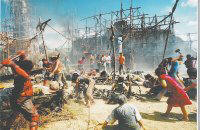
Whereas most horror films are content to kill off their cast 10 Little Indians-style over their run time, Hell disposes of its predominantly twenty-something group of protagonists with a bone crunching auto accident in its opening reel, depositing them in the titular afterlife dimension. After a flashback fills in pertinent character information as to why they may be facing damnation, we follow our seven leads as they try to escape their sentence with the legions of Hell in hot pursuit. Like a Hieronymus Bosch painting come to life, the film makes good use of its presumably meager budget, creating a rather convincing hellscape in which agonizing punishments are doled out by grey-skinned tormentors. Needless to say, not all will escape, but refreshingly, some who are left behind realize that they must serve their punishment before reincarnation (This is the Buddhist afterlife after all). The story telling gets a little rocky in portions, but not enough to detract from the overall inventiveness of the storyline. |
 Tokyo
Zombie
Tokyo
Zombie Midnight,
My Love
Midnight,
My Love The
Wedding Party
The
Wedding Party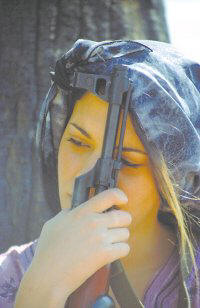
 Hell
Hell