2004 Philadelphia Film Festival Review
Part 2
By Rich Drees
 Bimmer
(Russia, 2003)
Bimmer
(Russia, 2003)
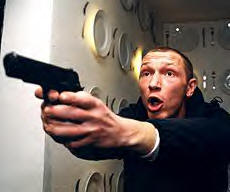
After a disastrous attempt to buy back a friend's stolen car ends with the death of an undercover cop, four young Russian petty criminals hit the road in this dark drama. The bleak landscape serves to accentuate their situation as they commit a series of small time scams to keep going. However, tempers inevitably flair as their predicament forces to spend all of their time together. This is an impressive debut feature from director Pyotr Buslov. While clearly a product of its own country, there are some echoes of American cinema. The grittiness of the film recalls early Scorsese or Tarantino's Reservoir Dogs, but the film is punctuated with moments of dark comedy that feel inspired by the Coen Brothers. Buslov still manages to take these influences and make his film uniquely his own. Each of the four criminals are fairly likeable characters, simply trapped in situations out of their control and it's heartbreaking to watch them on the road to their inevitable tragic end. The only drawback to the film was that it contains perhaps some of the worse subtitling I've seen in a long time. Hopefully this will be fixed if Bimmer gets any larger distribution in the United States.
Free Radicals (Austria/Switzerland/Germany, 2003)
Chaos theory espouses that no action's consequences can be completely predicted. The death of a young woman, Manu, in an auto accident sends the lives of family and friends spiraling onto new paths. Her best friend is consumed with the twin guilt of not being in the car with Manu that fateful night and over having an affair with Manu's husband. Manu's daughter becomes withdrawn from her surroundings while the teen driver of the other car has to deal with the guilt he feels over the accident paralyzing his girlfriend. One character, a mathematics teacher, claims that there are patterns in chaos, but by the time the final credits roll, one is hard pressed to find any unifying theme between all the characters. Besides the fact their lives have all spun off in unanticipated directions, there are no common bonds between their experiences and how they affect them. The film strives to be contemplative but comes of as unfocused and muddled. The movie also suffers from an excess of characters and plot lines, making it hard to get to the know any of the characters outside of the broadest outlines. Consequently, you can never really care that much about any of them.
 Lightning
Bug (United States, 2004)
Lightning
Bug (United States, 2004)
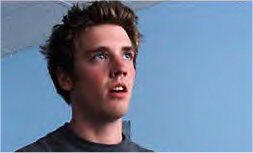
For many adolescents, movies can be a form of escape. For Green (Bret Harrison), horror movies not only help him escape from the reality of his unhappy home life, but his natural talent at creating gory makeup effects and monster masks offers him the hope of a better life working in the film industry. He finds a kindred spirit in video store clerk Angevin (Laura Prepon). Unfortunately, as he helps prepare the town's annual haunted house he runs afoul of Angevin's mother, a Bible-thumper who sees his interests as a sign of devil worship. This is a rather personal film for director Robert Hall, who when questioned during the question and answer period after the screening, declined to state exactly how much was fictionalized and what was based on true events. Hall has earned his living Hollywood as a makeup designer for film and television. His love for the horror films of his youth is clearly evident as the film contains a few veiled nods to the horror films of the 80s. Sharp-eyed fans of TV's Buffy, The Vampire Slayer and Angel may recognize a few familiar demonic faces in Green's bedroom (from Hall's work on those shows) while Hellraiser fans will chuckle at the cover story on the issue of Fangoria magazine that Green's mother (Ashley Laurence) buys for her son at the grocery store. While the deeply religious mother straddles the line between character and stereotype, wavering between the two at times, the film is a finely crafted tribute to not only daring to dream but also acting on those dreams.