12th Annual Philadelphia Film Festival
Part 1
By Rich Drees
The sign of a good film festival is a schedule with more movies that you want to see than is humanly possible to. Such is the case with this year’s Philadelphia Film Festival. Even after a week of studying the festival’s program booklet and consulting a map of the city’s transportation system, there were still some films that I just wasn’t able to fit into my schedule. (And there’s always the frustration of having three “must see” films scheduled opposite of each other and northing else of interest for the rest of the day…)
Here’s a look at a few of the films that have screened that I was able to catch at this year’s festival-
Spring Subway (2002, China)
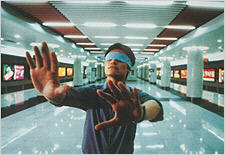 The modernistic, sterile gleam of Beijing is the backdrop for this story of
a marriage that has grown cold. Young lovers Jian Bin and Xiao Hui arrived
in the city barely out of their teens with nothing but their love for each
other and hope for the future. Seven years later, their marriage has grown
cold. Jian has been out of work for three months, but hasn’t been able to
tell Xiao. Instead, he spends his day riding the subway. Xiao begins a
flirtatious relationship with another man.
The modernistic, sterile gleam of Beijing is the backdrop for this story of
a marriage that has grown cold. Young lovers Jian Bin and Xiao Hui arrived
in the city barely out of their teens with nothing but their love for each
other and hope for the future. Seven years later, their marriage has grown
cold. Jian has been out of work for three months, but hasn’t been able to
tell Xiao. Instead, he spends his day riding the subway. Xiao begins a
flirtatious relationship with another man.
Spring Subway explores the consequences of what can happen to a relationship if a couple doesn’t continually work to make it successful. Neither one will admit that relationship is disintegrating and they are both afraid that if they split they will never find the passion they shared in their youth with another. Ultimately, the couple is faced with the question that if they are to continue their marriage should they do so because of the time they have already invested in their relationship or because they truly love each other.
The film is engagingly directed. In an interesting conceit, the couple’s history is told through flashbacks that are triggered by the characters moving through locations that hold a significance to them, such as the subway station they first arrived in Beijing in. The film does stumble a bit at the end though, with an over use of slow motion to convey emotion.
Sympathy for Mister Vengeance (2002, South Korea)
Following the success of his 2000 film Joint Security Area, director Park Chan-Wook successfully sidesteps any notion of a “sophomore slump” with this noir-ish thriller of tragic revenge.
When mute factory worker Ryu find out that he needs to raise money for an operation for his sister, he and girlfriend Youngmi devise a plan to kidnap the daughter of wealthy factory owner Dongjin. But when the girl accidentally drowns and Ryu’s sister commits suicide, Ryu and Dongjin find themselves locked into a downward spiral of revenge.
 There are moments in this movie that teeter between the blackest of dark
comedy and heart wrenching tragedy. The scene where Ryu says his final
goodbye to Youngmi is shot simply but conveys a world of emotion.
There are moments in this movie that teeter between the blackest of dark
comedy and heart wrenching tragedy. The scene where Ryu says his final
goodbye to Youngmi is shot simply but conveys a world of emotion.
This is a movie about violence, but it’s not a particularly violent movie. What violence does occur is quick, graphic and ugly but never gratuitous. If it shocks, it’s only due to the naturalistic way it’s depicted. The characters lives are shattered by their violence. There are no heroes or villains, only victims and ultimately, we are left wondering who, if anyone, we should be feeling sympathy for.
R. T. Herwig’s The Good Thief (2002, United States)
Not to be confused with the new film from Neil Jordan (which someone on the festival staff did so that’s how I and many other others wound up seeing this instead of the aforementioned Jordan film), this is an independent feature shot locally and surrounding areas using some of the most crumbling Philadelphia locations seen in a film since Terry Gilliam’s 12 Monkeys.
Christopher Doogan is returning home after spending four years in prison, determined to turn his life around. Standing in his way are an unsupportive and alcoholic father, an ex-wife who has told his daughter that he is dead and his former friends, the criminals whom he went to prison for.
Christopher Kadish plays Doogan the best he can with what the script gives him, which isn’t much. The script is rather thin, padded out with numerous arguments over dinner, sage conversations with grandma and agonizing over beer before we reach an ending that strains credulity. The film is moodily shot with some good use of lighting, but an overabundance of Dutch angle camera shots makes me wonder if Herwig watched too many reruns of the old 1960’s Batman TV series as a kid. Also, the overuse of smoke makes one wonder if it’s supposed to take place in Philadelphia or London.
Dark Water (2002, Japan)
From Hideo Nakata the Japanese director of Ringu, comes his latest foray into the supernatural Dark Water.
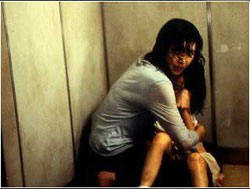 Yoshimi is a mother struggling to keep custody of her five-year old daughter
Ikuko from her ruthless husband who is using her past history of seeking
psychiatric help against her in the custody battle. But soon after Yoshimi
and Ikuko move into a rather creepy apartment plagued by a leaking ceiling,
Yoshimi keeps seeing a ghostly little girl. Yoshimi begins to question her
own sanity when she discovers that the girl she is seeing supposedly died
years before. Yoshimi now must race to find out why the girl is haunting her
before something happens to her own daughter.
Yoshimi is a mother struggling to keep custody of her five-year old daughter
Ikuko from her ruthless husband who is using her past history of seeking
psychiatric help against her in the custody battle. But soon after Yoshimi
and Ikuko move into a rather creepy apartment plagued by a leaking ceiling,
Yoshimi keeps seeing a ghostly little girl. Yoshimi begins to question her
own sanity when she discovers that the girl she is seeing supposedly died
years before. Yoshimi now must race to find out why the girl is haunting her
before something happens to her own daughter.
Nakata re-uses many of the same elements here that he used in Ringu and continues Ringu's sub-textual mourning for the loss of the traditional family. Some fans of Ringu may find Dark Water lacking the plot complexity of the earlier film, but it is no less scary. Without Ringu’s “Seven days until you die” ticking clock, Nakata manages to increase the tension until the film’s climactic sequence. Much in the same way Jaws made people think twice about a trip to the beach, Dark Water will have you nervously eyeing any dripping ceilings for sometime to come.
Cinemania (2001, Germany/United States)
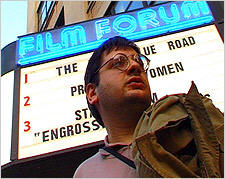 Cinemania paints portraits of five New York City film fans who have
taken their love of the art of the motion picture to the extreme. None hold
regular day jobs (Three receive disability benefits, one does temp work and
one is living off of an inheritance from the proverbial deceased rich
relative) and for the most part have little or no relationships with friends
or their own families.
Cinemania paints portraits of five New York City film fans who have
taken their love of the art of the motion picture to the extreme. None hold
regular day jobs (Three receive disability benefits, one does temp work and
one is living off of an inheritance from the proverbial deceased rich
relative) and for the most part have little or no relationships with friends
or their own families.
"Commitment to cinema is a commitment to a technically deviant lifestyle," states Jack, arguably the most grounded of the five, at least as presented here. In fact, most of the five state that they recognize that their behavior falls outside of "normal" but they're not terribly concerned by that. There's nebbishy Bill, the self-described writer and philosopher, who is looking for a woman who could share his interest in post-War European and Italian expressionistic cinema. He also is militantly against the Museum of Modern Art selling popcorn at their screenings. Harvey has an almost Rain Man like knowledge of movie running times. Eric seems to find the good in every film, no matter how bad or cheesy. Then there's Roberta, who has been banned from MoMA for assaulting an usher who ripped her ticket the wrong way.
A captivating documentary, Cinemania never mocks its subjects and never delves too deeply into the root of their devotion to film. It simply presents these people as they are and allows the audience to draw their own conclusions. And some of us will very well conclude “There, but for the grace of God, go I.”